

Innovative road markings for motorcyclists
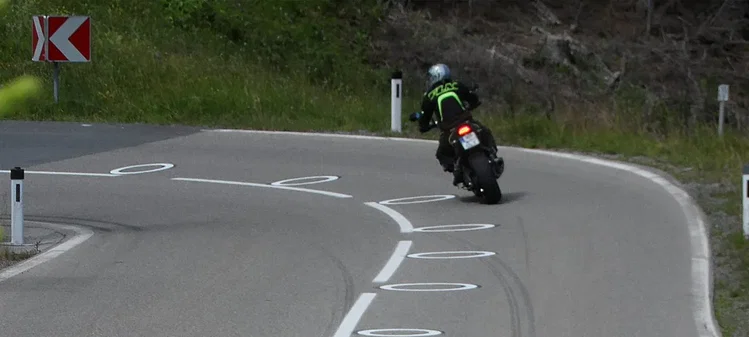
A research project is currently under way in Norway looking at special road markings for motorcyclists, using methods including eye-tracking. The aim is to find out whether small visual changes in the road environment can help riders choose a safer line and make better decisions as they approach and ride through a bend.
The method itself is not new. Similar markings have been used in Austria for several years, where substantial reductions in motorcycle accidents have been reported at selected high-risk bends. In Scotland, a different visual system has been tested on tens of thousands of passing motorcyclists, using markings that create small “gates” on the road. Norway now wants to understand more about why these systems work.
A small marking with a clear purpose
The basic idea is simple.
The problem is particularly noticeable in blind left-hand bends. A motorcyclist may choose too tight a line, and even if the bike itself remains on the correct side of the centre line, the rider’s upper body can lean dangerously close to, or sometimes directly into, the path of oncoming traffic.
The white ellipses used in Austria are therefore placed close to the centre line. The idea is not for the rider to ride over them, but rather the opposite.
Riders tend to avoid road markings, and by placing the ellipses strategically, the line through the bend can be guided further away from oncoming traffic. Austria’s KFV, Kuratorium für Verkehrssicherheit, describes this as visual guidance that helps motorcyclists maintain a greater safety margin from the centre line.
There is no physical barrier and nothing forcing the rider to take a particular line. It is more of a subtle visual nudge.
Austria was first
Austria has been working with special motorcycle road markings since 2016. In an early study, both ellipses and transverse markings were used in eight selected bends. When KFV followed up the results a few years later, the number of motorcycle accidents involving injury in the bends studied had fallen by around 42 per cent overall.
In the bends where ellipses were used, no motorcycle accidents involving injury were recorded during the follow-up period. Riding behaviour changed as well. Before the markings were introduced, around 36 per cent of motorcyclists chose the safer, outer part of the lane at the apex of the bend. By the 2020 follow-up, that figure had risen to 68 per cent.
80 per cent fewer accidents
In 2019, Austria expanded the work with a larger project in Tyrol. Together with regional authorities and road operators, KFV identified a number of problem areas and installed elliptical road markings in 19 particularly critical bends.
When the project was evaluated, only four motorcycle accidents involving injury had been recorded in those 19 bends between July 2019 and the end of 2021. KFV estimated the reduction in accidents at around 80 per cent, even after taking the lower traffic volumes during the pandemic into account.
The experience has since led to the method being introduced at more high-risk bends in Austria. In 2024, KFV stated that similar solutions were being used at around 70 high-risk bends in Austria and that the method had also attracted international interest.
The idea is not to paint ellipses on every bend. It is a targeted safety measure for locations where accident data or rider behaviour point to a particular problem.
Scotland chose a different type of marking
Scotland has worked with the same basic principle, but using a different visual system. The project is called PRIME, Perceptual Rider Information for Maximising Expertise and Enjoyment. Instead of ellipses, the markings consist of three pairs of truncated chevrons that form something resembling gates on the road.
The idea is for the motorcyclist to ride through the opening between them. The markings are placed before the bend, rather than in it, to help the rider adjust speed, road position and braking before entering the corner.
During the first phase of the project, between 2020 and 2022, the system was installed at 22 trial sites in western Scotland, together with two control sites.
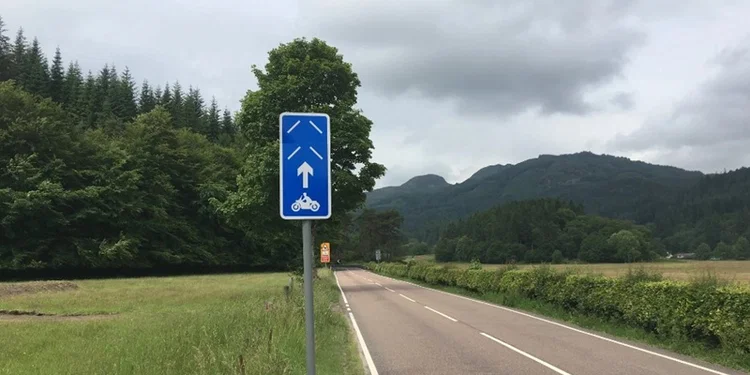
The researchers analysed 32,213 motorcycles. The results showed statistically significant reductions in speed at ten sites, improved positioning on approach to the bend at 15, and improved positioning at the apex at 13. At nine sites, braking within the bend itself was reduced. No corresponding statistically significant changes were observed at the control sites.
Transport Scotland has since continued the project. In the second phase, from 2023 to 2025, the trial was expanded to a total of 35 sites and more than 47,000 motorcycle passes were analysed. The results continued to show changes in areas such as road position, speed and braking behaviour. Follow-up studies at the same sites after two, three and five years showed that the changes in rider behaviour were sustained over the longer term, rather than being only a temporary effect shortly after the markings were installed.
Not a solution for every road
The Scottish project also shows how selectively this type of measure is intended to be used. PRIME has primarily been developed for demanding bends on two-lane rural roads. The markings have not been tested on motorways, dual carriageways or single-track roads, for example, and Transport Scotland does not consider them suitable everywhere.
Before installation, factors such as approach speed, road gradient, whether the rider is coming from a straight section or a previous bend, and the layout of the road itself are analysed. Even the spacing between the markings is adapted to the speed motorcyclists typically travel at when approaching the bend.
Norway focuses on where riders look
TRAFIKKLAB at Nord University is carrying out a study funded by the Norwegian Public Roads Administration to investigate how motorcycle-specific road markings affect attention, behaviour and safety in bends. The first round of data collection was carried out on a stretch of road near Lillestrøm, outside Oslo.
A total of 51 motorcyclists with different levels of experience took part. The group rode several different types of motorcycle, ranging from sports and touring bikes to enduro bikes and electric motorcycles. The riders were equipped with eye-tracking glasses that recorded exactly where they were looking while riding. After calibration, each participant rode a route lasting around 20 minutes.
The researchers then supplemented the measurements with interviews about how the riders themselves perceived the markings and the road environment. The question is not only whether a rider ends up on a better line. The researchers also want to know what happens to their attention on the way there.
Do the markings help – or draw the rider’s attention away?
There is one particularly interesting aspect of the Norwegian study. If the markings help riders read the bend and choose a safer line, they could be highly valuable. But if they instead draw attention away from oncoming traffic, the road surface or other hazards, the effect could be very different.
Nord University is therefore investigating both whether the markings help riders find a better line and whether they risk shifting attention away from other important parts of the traffic environment. The results of the Norwegian eye-tracking study have not yet been published. The first round of data collection has been completed and the material will now be analysed further.
International developments
In Germany, the state of North Rhine-Westphalia has been running its own pilot project with elliptical road markings since May 2023 on a winding rural road in the Eifel region, in collaboration with RWTH Aachen. Early results point in the same direction as those seen in Austria. Transport Scotland also reports that its PRIME toolkit has attracted interest from the rest of the UK, mainland Europe and countries as far afield as South Africa and Australia.
What began as local trials in a handful of high-risk bends has, within just a few years, become an issue being discussed on several continents at the same time.
Facts: three ways to guide riders through a bend
🇦🇹 Austria – ellipses in the bend
White ellipses are placed close to the centre line in particularly problematic bends. Since riders tend to avoid crossing road markings, this steers their line further away from oncoming traffic. In a project covering 19 high-risk bends in Tyrol, Austria’s KFV reported around 80 per cent fewer motorcycle crashes after installation.
🏴 Scotland – “gateways” before the bend
The PRIME markings consist of three pairs of markings that form visual gateways ahead of demanding bends. They’re designed to help riders adjust position, speed and braking before the turn itself. Studies covering tens of thousands of motorcycle passes have shown statistically significant improvements at many of the trial sites.
🇳🇴 Norway – eye-tracking
Nord University is studying how motorcycle-specific road markings affect riders’ attention. 51 riders have ridden a test stretch wearing eye-tracking glasses. The results of the analysis have not yet been published.

Anna Haglund